


Stageira – Birthplace of Aristotle
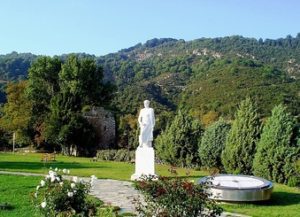 Aristotle the leading philosopher of antiquity and teacher of Alexander the Great. The city was founded in 655 BC, by Ionian settlers on the island of Andros. After the Persian wars, the Stageiras became part of the First Athenian Alliance, contributing to the common fund. However, during the Peloponnesian War and specifically in 424 BC, the city revolted from the Athenians and allied with the Spartans. The event infuriated the Athenians, who hurried to besiege the city, but to no avail. Later, however, Stageira proceeded to the Common of Halkidiki, the confederation of all the cities of Halkidiki based in Olynthos. In 349 BC. the city was besieged and then succumbed to the king of Macedonia Philip II, who completely destroyed it, but to re-establish it a few years later himself,
In the last decade, systematic excavations, landscaping and restorations have created an important archaeological site, next to the community of Olympiada, the village that today is located near the ancient Stageira. These eventually led to the systematic excavations by the 16th Ephorate of Prehistoric and Classical Antiquities, which continue to this day and have brought to light important findings and facts about the birthplace of Aristotle. In 1995, a restoration program for the southern part of the fortification began. The restoration works aim at the maintenance and restoration of part of the wall, a circular tower and the large square tower with interventions on a relatively large scale, as it is planned to be in the future points of view of the visitors of the archaeological site. Aristotle was the leading philosopher of antiquity, along with Plato, and at the same time a scientist, as long as he was a historian, sociologist and forerunner of biology. He was born in 384 BC. in Stageira of Halkidiki and died in 322 BC. in Chalkida. His father was Nikomachos, who was a doctor of the king of Macedonia Amyntas II. He studied near Plato at the Academy for twenty years from 366 BC. Philip II invited him to Macedonia in order to undertake the education and upbringing of his son, Alexander the Great. He established his school in Mieza, near today’s Veria, in an idyllic landscape, where the best young people of Macedonia studied. Later, Aristotle founded his own philosophy school in Athens, which he established in one of the three public high schools in Athens, the Lyceum. Aristotle’s theory is a central axis of his moral philosophy. In the context of this theory, Aristotle urges us, if we want to conquer virtue and become happy, to avoid extreme choices in our behavior. The archaeological site is always open.
For more information, we suggest you visit the following websites:ARISTOTLE`S PARK and Ancient Stagira
Ancient Akanthos
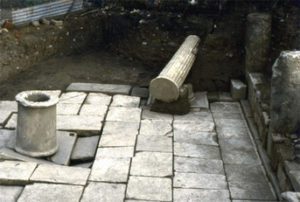 Ancient Akanthos is located on the northeastern side of the Coast, on the eastern peninsula of Halkidiki. Thucydides mentions Akanthos, while Plutarch as a mixed colony of Andrians and Haklides, founded in the “Coast of the Dragon”, in the place of pre-existing civilization. According to archeological data, the probable date of its foundation is 655 BC.
The ancient city stretches on a picturesque hill, about 600 meters southeast of the settlement of Ierissos, where relics of the walls, an impressive part of the citadel, scattered architectural members and building remains of Hellenistic times are preserved. In the same archeological site, a ruined Byzantine church and two post-Byzantine ones are preserved. Akanthos has not yet been systematically excavated, unlike the necropolis, whose research began as early as 1973. The cemetery is particularly extensive, it occupies the coastal part of Ierissos and has more than 600 tombs to date.
The archeological site is always open. For more information, we suggest you visit the following website: Ancient Acanthus
Ancient Olynthos
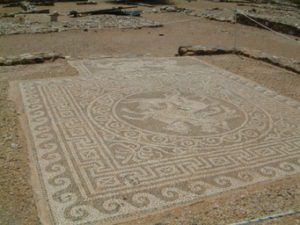 Olynthos was built between two plateaus, in a place with remains from the modern Neolithic era (3000 – 2500 BC). It was founded in the inland of the Toroneos Gulf with a settlement of many coastal settlements. Herodotus, however, writes that the city was built by the Vottians of Axios, who after their expulsion from the Macedonians, moved to Halkidiki. This settlement was destroyed in 479 BC. by the Persians, when they returned to Asia after their defeat at Plataea, and surrendered to the Chalcidians.
Its heyday dates back to classical times. He participated in the First Athenian Alliance (Delian Alliance) as an active member. In 440 BC. rebelled against the Athenians and within two decades became the most populous and richest city in the region, accepting waves of immigrants. In 432 BC. The “Common of Halkidiki” is founded, an alliance of 32 coastal cities of Halkidiki, based in Olynthos, a new city, built with the hippodameian system. Shortly after 440 BC, about 6,000 inhabitants flourished, while in the middle of the 4th c. its population reached 10,000. Due to its growing power, it clashes with Amyntas III of Macedonia (393 – 370 BC). For the same reason it is attacked by the Spartans (382 – 379 BC) who besiege and occupy it temporarily.
During the Theban hegemony, Olynthos regained its lost prestige and again broke with Athens (368 – 358 BC) for the region of Amphipolis. At this time it takes over the reins of the Common of Halkidiki and becomes the capital of the Halkidiki Alliance. However, Olynthos’ alliance with Filippos will not last long, as it opposes his plans. In 348 BC. Philip attacks the capital of the Common of Chalkida, flattens the city and sells its inhabitants as slaves. Since then, Olynthos has remained uninhabited. It is even said that Alexander the Great, although he greatly appreciated the Olynthian philosopher Kallisthenes, refused to grant his request and rebuild Olynthos.
The systematic excavation was started by the American School of Archeology under the direction of Professor D. Robinson (1920s). In 1990 the 16th Ephorate of Prehistoric and Classical Antiquities began the restoration of monuments and the promotion of the archaeological site.
-
- Opening hours: 8:30 – 15:30
- Ticket price: Full: € 3, Reduced: € 2
For more information, we suggest you visit the following website: Ancient Olynthos
Ancient Toroni – The fortress of Lekythos
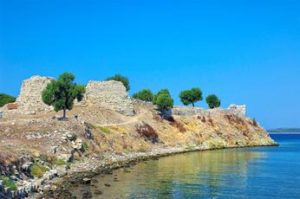 The excavations were carried out by the Ephorate XVI of Classical Antiquities in 1975. The ancient city extends in 3 main areas: (a) the Acropolis located on rocky and hilly terrain between Porto Koufo and Likythos, which was connected to the city by a large (b) the main ancient city located on the plateau southwest of the citadel to the coast and includes the fortress of Lekythos, and (c) the suburbs of the city, which are now in a narrow space but in antiquity was located in a much wider area land that connected Lekythos and the city.
During mythological times, Toroni was the wife of Proteus, son of Poseidon. Traces of prehistoric settlements dating back to the third millennium BC and many other relics of antiquity have been discovered. monuments in the early Christian and Byzantine times, which testify that the area has been continuously inhabited since the Neolithic Age. Ancient Toroni was founded by settlers from Chalkida during the 8th century BC. century. From the 5th BC. century, Toroni was already one of the most important cities of Halkidiki. She had her own currency and was a member of the Delian Alliance. Thucydides narrates that in 423 BC, the Spartan officer Brasidas took over the administration of the city. In 348 BC, the city was annexed to the State of Philip II of Macedonia. In 168 BC, the city was conquered by the Romans and declined. During the Byzantine era, the area consisted of estates that belonged to Mount Athos. Its strong walls and other buildings were destroyed in the 19th century, when the Turks used granite to open the main avenues in Constantinople and Thessaloniki. The findings from recent excavations confirmed the continuous residence of inhabitants in the area from the end of the Neolithic era to the Ottoman Empire.
Finds of architectural interest have been revealed, however they are not complete as most have been destroyed due to the constant use of the spaces. Archaeologists placed particular emphasis on the settlement’s cemetery from the Iron Age, which covered a period from the late 2nd century to the mid-9th century. 134 tombs were discovered in the cemetery, of which 118 contain ash, while 16 include simple burials. 500 containers were brought to the surface, which were used either as ashtrays or as gifts. The findings from recent excavations confirmed the continuous residence of inhabitants in the area from the end of the Neolithic era to the Ottoman Empire. Finds of architectural interest have been revealed, however they are not complete as most have been destroyed due to the constant use of the spaces. Archaeologists placed particular emphasis on the settlement’s cemetery from the Iron Age, which covered a period from the end of the 2nd century to the middle of the 9th century. 134 tombs were discovered in the cemetery, of which 118 contain ash, while 16 include simple burials. 500 containers were brought to the surface, which were used either as ashtrays or as gifts.
The findings from recent excavations confirmed the continuous residence of inhabitants in the area from the end of the Neolithic era to the Ottoman Empire. Finds of architectural interest have been revealed, however they are not complete as most have been destroyed due to the constant use of the spaces. Archaeologists placed particular emphasis on the settlement’s cemetery from the Iron Age, which covered a period from the end of the 2nd century to the middle of the 9th century. 134 tombs were discovered in the cemetery, of which 118 contain ash, while 16 include simple burials. 500 containers were brought to the surface, which were used either as ashtrays or as gifts.
The archeological site is always open. For more information, we suggest you visit the following website: http://en.wikipedia.org/wiki/Toroni